
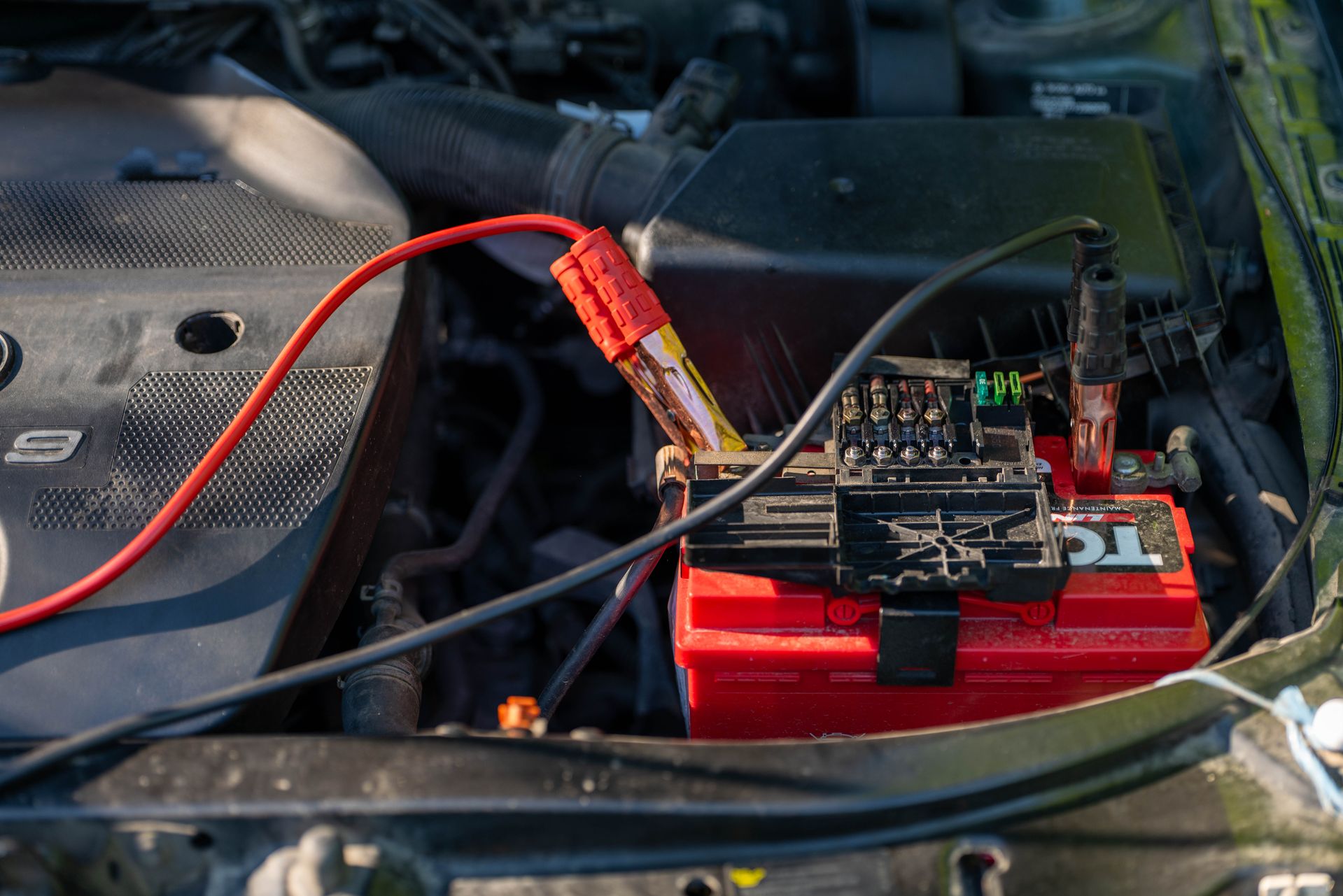
Click. Then silence. Nothing beats the sinking feeling of a dead battery. The good news is that knowing how to jump-start a car safely is easy once you know the order. The tricky part is knowing when a jump won’t fix the problem, or isn’t safe to try. Here’s how to do it right and spot bigger issues.
Before You Connect Anything
A few quick checks make the whole process safer. Start by reading your owner’s manual, since some vehicles have specific jump-start instructions, a dedicated positive terminal under the hood, or a remote jump point if the battery is located in the trunk or under a seat. Some manufacturers even advise against jump-starting certain models to protect their electronics, which is especially worth checking if you drive a hybrid or a newer European vehicle.
Next, look closely at the dead battery. If the case is cracked, bulging, or leaking, or if the battery looks frozen in extremely cold weather, don’t attempt a jump. A damaged or frozen battery can be dangerous. Also make sure the vehicles are turned off, in park or neutral with the parking brake on, and that the cars aren’t touching each other. If the battery terminals are covered in white or greenish crust, wipe them clean first, since dirty connections are one of the most common reasons a jump fails.
What You’ll Need
All it takes is a decent set of jumper cables and a second vehicle with a healthy battery, or alternatively a charged portable jump starter. Thicker cables with a lower gauge number generally carry current better and work more reliably than thin, cheap ones. The donor battery should be a similar voltage to the dead one, which is 12 volts for the vast majority of passenger vehicles.
The Correct Order – Step by Step
The order of the connections matters. It’s what protects you from sparks and protects both vehicles’ electrical systems. Here’s the standard sequence:
- Connect one red clamp to the positive (+) terminal of the dead battery.
- Connect the other red clamp to the positive (+) terminal of the good battery.
- Connect one black clamp to the negative (–) terminal of the good battery.
- Connect the last black clamp to a clean, unpainted piece of metal on the dead car, such as a bolt on the engine block or a sturdy bracket, away from the battery, fuel lines, and moving parts. Don’t connect it to the dead battery’s negative terminal.
- Start the donor vehicle and let it idle for a minute or two to build up some charge.
- Try starting the dead vehicle. If it doesn’t start right away, wait a few minutes with the donor car running and try again.
- Once it starts, remove the cables in the exact reverse order: the black clamp from the unpainted metal first, then the black clamp from the good battery, then the red clamp from the good battery, and finally the red clamp from the formerly dead battery.
Throughout the process, never let the metal ends of the clamps touch each other or touch other metal surfaces while the cables are connected. If you’re alone, take extra care to keep each pair of clamps separated while you move between the cars.
Why the Last Connection Goes on Bare Metal
It’s tempting to clamp the last black cable onto the dead battery’s negative terminal, since that seems like the logical match. But batteries can release flammable hydrogen gas, and making that final connection creates a small spark. Attaching it to unpainted metal away from the battery keeps that spark away from the gas, which is a simple way to reduce the chance of a battery explosion or damage to the battery itself.
What to Do After the Car Starts
Don’t shut the engine off right away. Let it run, and take the car for a drive of about 15 to 30 minutes if you can, so the alternator has time to put some charge back into the battery. A short idle in the driveway isn’t enough. If the car dies again soon after you turn it off, the problem is probably bigger than a one-time drain, which is where the next section comes in.
When a Jump Won’t Help
Sometimes you do everything right, and the car still won’t start, or it starts and dies again soon after. That’s usually a sign the dead battery isn’t the whole story. Here are the most common situations where a jump won’t solve the problem:
- The battery is simply worn out. Batteries typically last several years, and an old one can fail to hold a charge no matter how many times it’s jumped. If the car starts after a jump but is dead again the next morning, it’s time for car battery testing and likely a replacement.
- The alternator isn’t charging. If the charging system warning light stays on or the car dies shortly after the cables come off, the alternator may not be recharging the battery, which means you’ll need alternator repair, not just a jump.
- There’s a parasitic drain. Something may be draining the battery while the car is off, such as a stuck relay, a faulty module, or an aftermarket accessory. A jump will get you going, but the battery will keep dying.
- The starter has failed. If you hear a single loud click, a grinding noise, or nothing at all, but the lights and radio work normally, the issue may be the starter rather than the battery, and starter repair is the fix.
- The battery terminals or cables are corroded or loose. Heavy corrosion or a loose cable can prevent power from flowing, even with a fully charged battery. Cleaning and tightening the connections sometimes resolves it, but severely corroded cables may need replacing.
- It’s a fuel or ignition problem. If the engine cranks normally but won’t start, the issue isn’t the battery at all. That points toward fuel delivery, spark, or a sensor problem, and it calls for engine diagnostics.
- The battery is completely dead or damaged. A battery that’s completely discharged, frozen, cracked, or physically damaged shouldn’t be jumped.
A Note on Hybrids and Electric Vehicles
Hybrid and electric vehicles still have a 12-volt battery that runs the computers and accessories, and when it dies, the vehicle may not “start” even though the large high-voltage battery is fine. Many of these vehicles can be jump-started at a designated terminal, but the procedure varies, and some manufacturers have specific warnings. Always check the owner’s manual first, and if you’re unsure, it’s smart to call a shop that handles hybrid car repair rather than risk damaging sensitive electronics.
Common Mistakes to Avoid
A few mistakes cause most of the trouble. Mixing up the clamps, so that positive and negative are reversed, can damage electronics and blow fuses, so double-check your connections before starting anything. Letting the clamps touch each other while connected can cause sparks. Revving the donor engine hard is unnecessary and can cause voltage surges. And rushing through the steps or skipping the unpainted-metal ground are among the most common reasons jumps fail or cause damage.
Should You Keep Jumper Cables in the Car?
It’s worth it. A set of jumper cables or a compact portable jump starter takes up very little space and can save you a long wait for roadside help. Portable jump starters are especially handy since you don’t need a second vehicle, but they need to be kept charged to be useful. Whichever you choose, it helps to know how to use it before you actually need it.
Don’t Let a Jump Be the End of the Story
A jump-start is a quick fix for a symptom, not a cure for the cause. If your battery died once, it’s worth finding out why, whether that’s age, a weak charging system, or something draining power overnight. A quick check at a trusted shop now can save you from getting stranded again later. Making car battery testing part of your regular preventative car maintenance, especially before the temperature swings of fall and winter, is one of the easiest ways to avoid being caught off guard.
Needed a jump and not sure why your battery died? Bring your vehicle in, and we’ll test the battery, alternator, and starter to find out what’s really going on. Contact us or drop by our shop to schedule an appointment.