
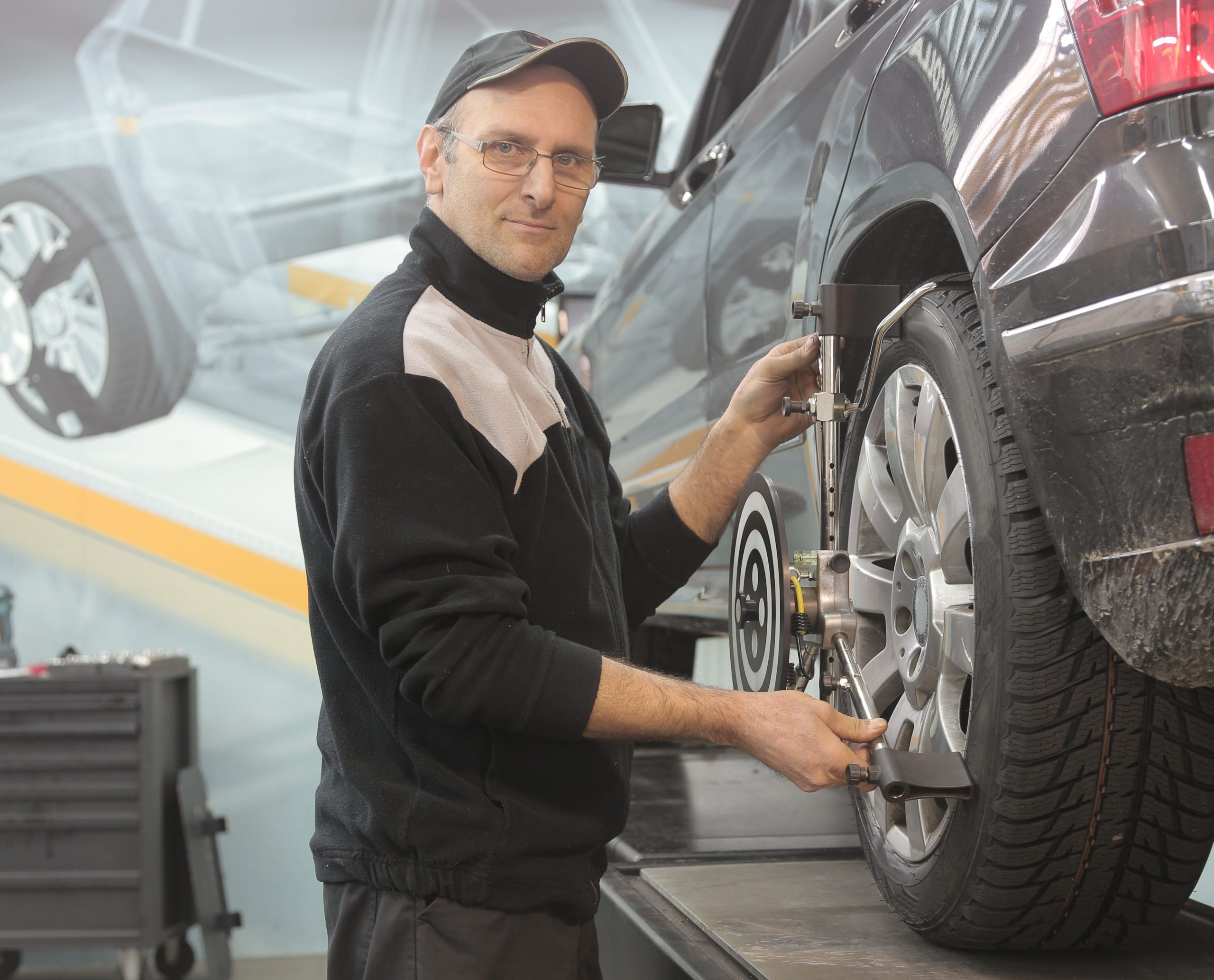
Do you know why wheel alignment matters? Wheel alignment is easy to ignore because the damage it causes is slow and quiet. Your car won’t break down from bad alignment. Instead, it’ll just chew through tires faster, burn more gas, handle less predictably, and put extra strain on suspension parts that should last a lot longer. Most drivers don’t notice until they’ve already paid for it.
What Wheel Alignment Actually Means
Alignment is about the angles at which your tires meet the road, set by the manufacturer so your car tracks straight and tires wear evenly. Three angles matter most:
- Camber – the inward/outward tilt of the tire (front view). Too much either way wears the tread unevenly.
- Toe – whether the fronts of the tires point toward or away from each other (top view). Even slightly off, and you get fast, uneven wear.
- Caster – the steering axis angle (side view). Affects stability and how the wheel returns to center after a turn.
Why Alignment Goes Out of Spec
A lot of drivers assume their alignment only needs attention after an accident or a major impact. That is not the case. Alignment drift happens through normal driving and does not require anything dramatic to trigger it.
Potholes are the most common culprit, and anyone driving in the Bossier City area knows that Louisiana roads give your suspension a workout year-round. A hard hit on a pothole transfers a sudden lateral force through the tire and suspension that can shift alignment angles measurably in a single impact. Curb strikes during parking, speed bumps taken too fast, and even accumulated wear on suspension bushings and ball joints over time all contribute to alignment moving out of spec.
Suspension component wear is particularly important to understand because it creates a maintenance chain. Worn ball joints, control arm bushings, or tie rod ends change the geometry of the suspension, which shifts the alignment. An alignment performed on a vehicle with worn suspension components will not hold because the underlying geometry keeps moving. This is why a thorough suspension inspection is part of any proper alignment service.
What Misalignment Actually Costs You
This is where most drivers underestimate what bad alignment is doing to them. The costs are real, but they accumulate silently, which makes them easy to dismiss until they add up to something significant. Here is what misalignment is quietly doing to your vehicle:
- Tires wear out faster – sometimes cut in half. A $$50,000-mile set might not make it past 25,000.
- Worse gas mileage – tires fighting each other means the engine works harder.
- Sketchier handling – wandering, pulling, vague cornering. Not great in an emergency.
- More wear on suspension and steering parts – ball joints, bearings, bushings all take the hit.
- Uneven brake wear – from lopsided weight distribution during braking.
How to Tell If Your Alignment Is Off
Some alignment issues are obvious. A vehicle that pulls strongly to one side when you let go of the wheel on a flat, straight road is a clear signal. A steering wheel that is visibly off-center when driving straight is another. These are the cases that most people eventually bring in because they are impossible to ignore.
What is trickier is the subtle misalignment that does not cause obvious pulling or steering complaints but is still wearing your tires and affecting your fuel economy. The best way to catch this is to look at your tire wear pattern. Wear concentrated on the inside or outside edge of a tire, rather than evenly across the tread, is a classic sign of camber issues. Wear that looks feathered or sawtoothed when you run your hand across the tread from side to side points to toe problems. Both patterns tell you the tire has been running at the wrong angle for a while.
If you are not sure what to look for, any auto repair shop with an alignment rack can measure your angles in minutes and tell you precisely where things stand relative to manufacturer specifications.
How Often Should You Get an Alignment Check?
The standard recommendation is to have your alignment checked once a year or every 12,000 miles, whichever comes first. Beyond that baseline, there are specific situations that warrant an alignment check regardless of when the last one was done:
After hitting a significant pothole or curb. After any suspension repair, since replacing components changes the geometry and requires the alignment to be reset. After installing new tires, they are an investment worth protecting from the start. After a fender bender or any impact that affected the front or rear of the vehicle. And any time you notice pulling, steering wheel off-center, or unusual tire wear.
On diesel trucks used for towing or hauling, more frequent alignment checks are worthwhile because the additional load and stress accelerates wear on the suspension components that keep the alignment in place. A truck that regularly carries heavy loads in the bed or tows a trailer is putting more strain on its front-end geometry than a vehicle used for light-duty driving.
Alignment and New Tires: Always Do Both
One of the most common mistakes drivers make is buying new tires and skipping the alignment check at the same time. New tires on a vehicle with bad alignment will start wearing unevenly from the first mile. Within a few thousand miles, that fresh set of tires has already developed an uneven wear pattern that cannot be undone even if the alignment is corrected later.
Getting an alignment whenever you install new tires is not an upsell. It is the only way to ensure the tires you just paid for wear evenly and last as long as they should. A wheel alignment service at the time of tire installation is the single best investment you can make to protect that purchase.
It Connects to More Than Just Tires
Wheel alignment sits at the intersection of tires, suspension, steering, and fuel economy, which means it affects more systems than most drivers realize. A vehicle with poor alignment is simultaneously burning extra fuel, wearing out tires prematurely, stressing suspension components, and handling less safely, all for the want of a service that takes less than an hour and costs a fraction of what any one of those consequences costs to address.
Future Auto Repair handles wheel alignment, suspension repair, and complete steering system service for all makes and models in Bossier City. Whether you are driving an Asian vehicle, a European car, a domestic truck, or a diesel, if you cannot remember when your last alignment was done, it is probably time. Stop by or contact us, and we will get it sorted.