
Your temperature gauge sits perfectly normal on the highway. But the moment you stop at a red light or pull into a parking lot, it starts creeping up. That’s a specific pattern, and specific patterns point to specific problems. The question is: Why does the engine run hot only when idling?
An engine that runs hot only at idle is not the same problem as an engine that overheats at all times. The distinction matters because the cooling system behaves differently depending on whether the vehicle is moving. Understanding why tells you a lot about where to look. Here’s what’s actually going on, and what each cause means for your vehicle.
First, Understand How Your Cooling System Works at Idle
When your vehicle is moving down the road, airflow does a significant portion of the cooling work. Air rushes through the grille, passes through the radiator, and carries heat away from the coolant before it cycles back into the engine. It’s a highly efficient process. It’s so efficient that at highway speeds, the cooling fan often doesn’t even need to run at full speed.
At idle, that airflow disappears. The engine is still producing heat, the coolant is still circulating, but now the radiator has to shed that heat without the help of road speed pushing air through it. That job falls entirely to the electric cooling fan, or on older vehicles, the engine-driven fan. If anything in that idle-cooling chain is compromised, the temperature climbs. The engine running fine at speed is actually a helpful diagnostic clue: it tells you the core cooling system is probably intact.
A Faulty Cooling Fan Is the Most Likely Cause
The electric cooling fan is the single most common reason an engine runs hot at idle but stays cool at speed. This fan is designed to pull air through the radiator when the vehicle isn’t moving fast enough to generate natural airflow. When it fails or runs at reduced speed due to a bad motor, relay, or control module, the radiator can’t shed heat fast enough during a long idle.
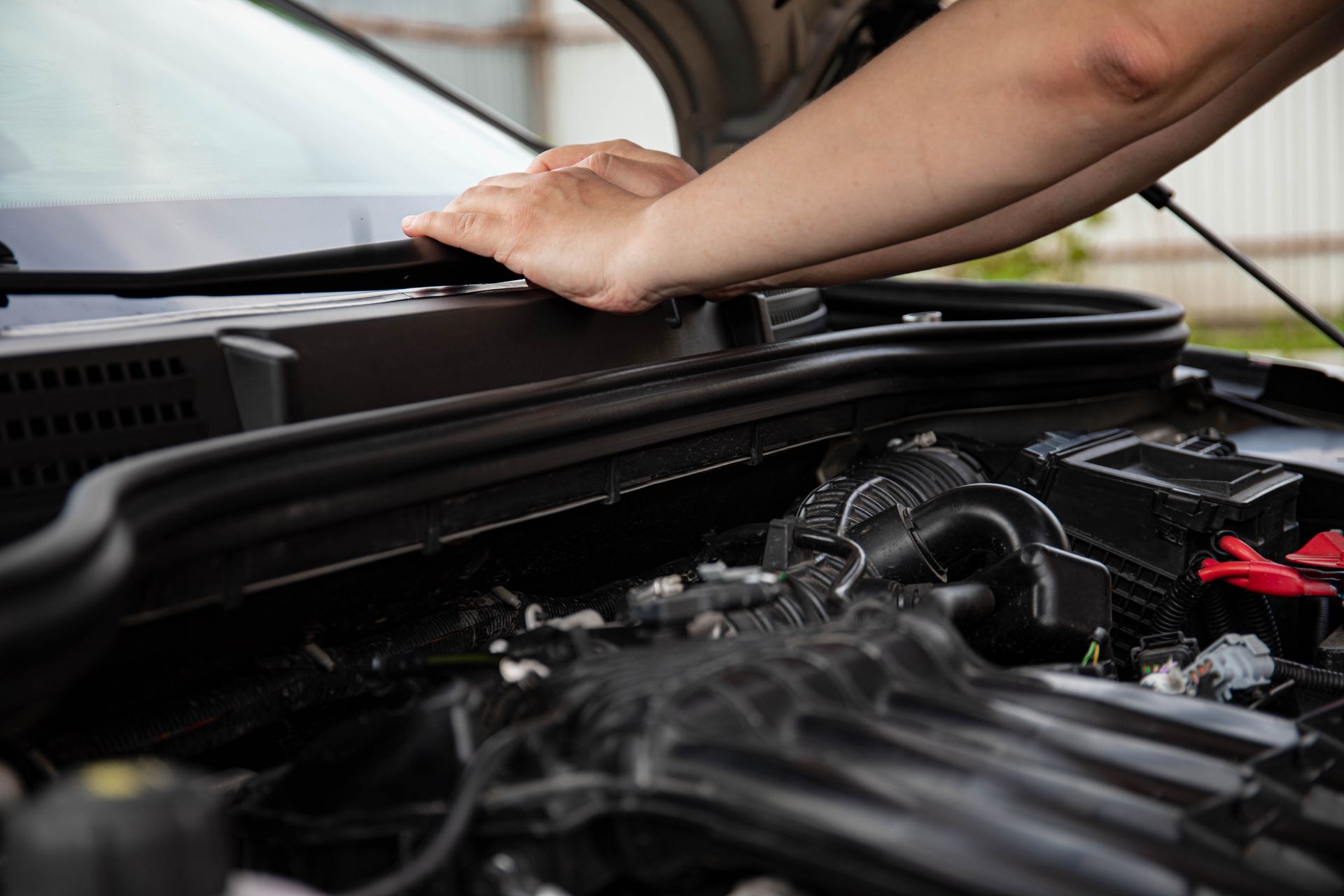
Fan failures are sometimes obvious. You can pop the hood while the engine is warm and the AC is running and see whether the fan is spinning. If it’s not running at all, or if it’s turning sluggishly when it should be at full speed, that’s your answer. But fan problems aren’t always a complete failure.
A fan motor that’s losing power gradually will still spin, just not fast enough to do the job properly in Louisiana’s summer heat. Diagnosing the difference requires testing the fan circuit, the relay, the temperature sensor that triggers the fan, and the fan motor itself under load.
Low Coolant or a Coolant Leak
Low coolant is another common cause of idle overheating, and one that’s easy to overlook because a small leak can take weeks to bring the level down noticeably. When coolant level drops, there’s less fluid in the system to absorb and carry heat away from the engine. At idle, where the cooling demands are already higher relative to airflow, even a moderately low coolant level can push the temperature gauge into the danger zone.
The tricky part is that coolant leaks aren’t always visible. An external leak under the vehicle is easy to spot, so you’ll see puddles or wet stains on the hose fittings, the radiator, or around the water pump.
But internal leaks are harder to catch. A failing head gasket can allow coolant to seep into the combustion chamber or the oil, where it disappears without leaving a puddle. Signs of an internal coolant leak include white smoke from the exhaust, a sweet smell from the tailpipe, coolant level that keeps dropping without an obvious external source, or a milky residue on the oil dipstick.
A Stuck or Failing Thermostat
The thermostat is a small valve that regulates coolant flow based on engine temperature. When the engine is cold, it stays closed to help the engine warm up quickly. Once the engine reaches operating temperature, it opens to allow coolant to circulate through the radiator and cool down. When a thermostat fails in the partially closed or stuck position, coolant flow is restricted, and the engine temperature rises.
A thermostat that’s stuck partially closed will often cause the temperature gauge to sit higher than normal during everyday driving, then creep into the red during extended idling. It may also cause the heater to blow inconsistent warmth, hot one moment, cooler the next, as coolant flow fluctuates.
A Clogged or Restricted Radiator
Radiators accumulate deposits over years of service. Mineral scale from old coolant, rust particles from corroding components, and debris that enters through damaged fins all reduce the radiator’s ability to transfer heat. A radiator that’s 30% clogged internally may perform adequately at highway speeds where airflow is helping but fall short at idle when heat transfer efficiency matters most.
External restriction is also possible. Bugs, dirt, leaves, and road debris pack into the fins over time and reduce airflow through the radiator core. This is especially common in areas with lots of insects or after driving through a lot of construction debris. A thorough radiator inspection looks at both internal flow and external fin condition.
The Water Pump May Not Be Moving Enough Coolant
The water pump is what keeps coolant circulating through the entire cooling system. It’s driven by the serpentine belt or timing belt on most vehicles, which means it’s always spinning when the engine runs. But a water pump that’s worn or failing can lose pumping efficiency gradually, moving less coolant than the system needs.
At highway speeds, reduced coolant flow is partially offset by the strong airflow through the radiator. At idle, where the radiator is already working harder, inadequate coolant circulation shows up as overheating. Warning signs of a failing water pump include a coolant leak from the weep hole near the pump, a grinding or whining noise from the front of the engine, or visible play in the pump pulley when the engine is off. If the water pump is on the timing belt, most shops, including ours, recommend replacing it during the timing belt service.
Air in the Cooling System
Air pockets trapped in the cooling system are an underappreciated cause of idle overheating. Coolant is a liquid and transfers heat efficiently. Air doesn’t. When an air bubble forms in the system, typically after a coolant repair, a head gasket failure, or a low coolant condition, it creates a hot spot wherever it sits. If that air pocket settles near a temperature sensor, the sensor may not read accurately. If it settles in a coolant passage near the engine, that area runs hotter than it should.
Air in the cooling system often produces erratic temperature gauge behavior. The needle may fluctuate rather than climb steadily, or the heater may blow cold intermittently even when the engine is warm. Properly bleeding the cooling system after any repair that opens it is essential. If air is the culprit in your idle overheating, the fix is a thorough system bleed, but the source of the air (usually a leak or a head gasket) needs to be addressed first, or the air will return.
Don’t Wait on This One
An engine that runs hot at idle is sending a clear warning. Overheating, even brief, repeated overheating, causes real damage. Warped cylinder heads, blown head gaskets, and scored engine components are all downstream consequences of an engine that runs too hot too often. The repair cost for those problems is many times what it costs to fix the cooling issue that caused them.
If your temperature gauge is climbing at idle, contact us and bring your vehicle into Future Auto Repair in Bossier City before it goes any further. We’ll inspect the cooling fan, test the thermostat, check coolant level and condition, pressure-test the system for leaks, and evaluate the water pump and radiator. We’ll find the actual cause and give you a straight answer on what it takes to fix it.