
You’re cruising down the road, hands lightly on the wheel, and you notice it: your car keeps drifting toward the shoulder or veering into the next lane. You correct it, but a few seconds later, there it goes again. So, what does it mean when the car pulls to one side?
If this sounds familiar, you’re dealing with one of the most common (and most misunderstood) car complaints out there. The good news is that a car pulling to one side almost always has a clear, fixable cause. The bad news? Ignoring it can turn a simple fix into a much bigger repair bill. Let’s break down what’s actually going on under your car and what it might take to fix it.
What Does It Mean When the Car Pulls to One Side?
A car should travel in a straight line when you’re driving on a level road with the steering wheel centered. If it consistently drifts or pulls to the left or right, it usually means one or more components affecting steering, braking, suspension, or tire performance aren’t working correctly.
While the problem may be as simple as low tire pressure or an alignment issue, it can also indicate more serious mechanical wear that should be inspected before it affects your safety or leads to more expensive repairs. Several issues can cause your vehicle to pull to one side, and understanding the most common culprits can help you recognize the warning signs.
Wheel Alignment
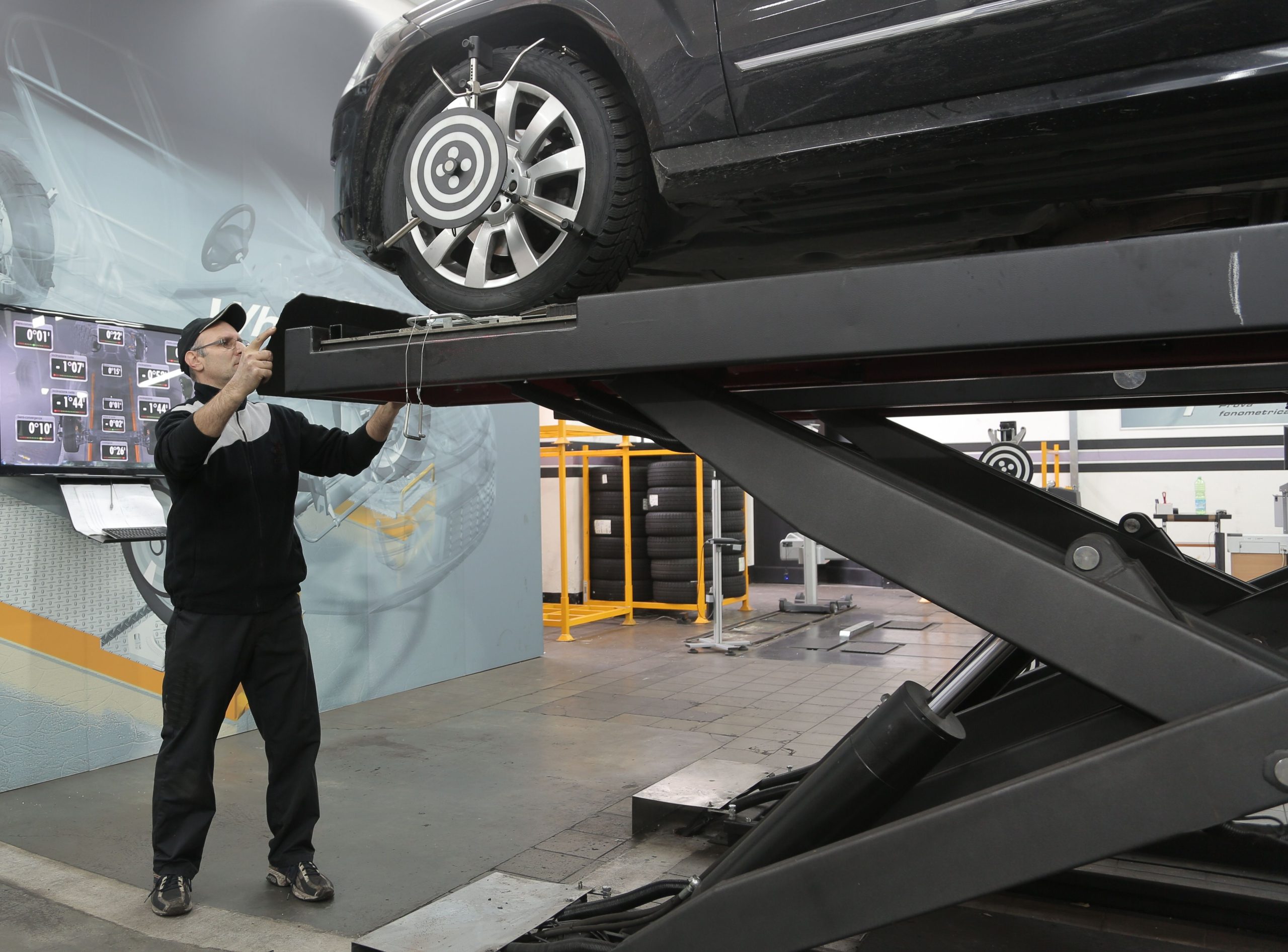
Nine times out of ten, when people bring their car in complaining about pulling, the answer is wheel alignment. Your wheels are supposed to sit at very specific angles relative to the road and to each other. Hit a deep pothole, curb a tire, or just let normal wear go unchecked, and those angles shift out of spec.
When your alignment is off, one wheel is essentially trying to steer a slightly different direction than the others, and your car naturally drifts toward whichever way it’s pulling. This also causes uneven tire wear, so if you notice your tread wearing faster on one edge, that’s another clue pointing straight at alignment.
The fix is usually straightforward: a wheel alignment service at a trusted auto repair shop will get all four wheels pointed the right way again. It’s one of the most affordable services on this list and often solves the problem entirely.
Uneven or Worn Tires
Sometimes the wheels are perfectly aligned, but the tires themselves are the problem. If one tire has significantly less tread than the others, or if the tire pressure is uneven side to side, your car will naturally pull toward the side with more resistance or less air.
Check your tire pressure monthly (yes, actually monthly) and rotate your tires as part of your regular oil change and preventative car maintenance routine. It’s a five-minute check that can save you from chasing a phantom alignment issue that’s really just a low tire.
Brake Problems
Here’s one that catches people off guard: brakes can absolutely cause a pull, even when you’re not braking. If a brake caliper is sticking or a brake line is partially blocked, one side of your car ends up with more drag than the other. That constant, uneven resistance pulls the car in that direction all the time, not just when you hit the pedal.
If the pulling gets noticeably worse when you brake, or if you hear grinding or feel pulsing, don’t wait. This is a safety issue, and it’s time for brake repair, not a DIY guessing game. A qualified shop can inspect your calipers, rotors, and brake lines to pinpoint exactly what’s dragging.
Suspension Issues
Your suspension system is what keeps each wheel planted evenly on the road. When a component like a ball joint, bushing, or strut wears out on one side, that corner of the car sits or reacts differently than the rest. The result is a pull, along with a rougher ride and possibly a clunking noise over bumps.
Suspension repair isn’t always urgent the moment you notice a pull, but worn suspension parts accelerate tire wear and throw off your alignment again after it’s fixed, so it’s worth having it checked out sooner rather than later.
Uneven Tire Wear from a Bad Wheel Bearing
A failing wheel bearing doesn’t just make noise (that low hum or growl that gets louder with speed). It can also let the wheel wobble ever so slightly, which changes how that tire grips the road compared to the others. Combined with the humming sound, a pull toward one side is a pretty reliable sign your bearing needs attention.
Don’t Forget the Basics – Engine and Drivetrain
Less commonly, a pull can trace back to the powertrain itself. Uneven power delivery from a transmission that’s slipping, or a differential issue in all-wheel-drive vehicles, can cause one side to grab the road differently than the other. If your car pulls specifically during acceleration, transmission repair or a look at the drivetrain might be in order.
This is also a good moment to mention engine diagnostics. Modern cars run on computers as much as mechanics, and a proper diagnostic scan can rule out (or rule in) issues you’d never catch by ear alone. If your shop can’t find a mechanical explanation for the pull, a full diagnostic check is the next logical step.
Quick Checklist – Signs Pointing to Each Cause
Not every car that pulls to one side has the same problem. In many cases, the way your vehicle behaves can provide important clues about what’s causing it. Not sure where to start? Here’s a simple way to narrow it down before you even call the shop:
- Pulls all the time, tires wearing unevenly on one edge – Likely wheel alignment.
- Pulls worse when braking, or grinding/pulsing felt – Likely brake repair needed.
- Humming or growling noise that grows with speed – Possible wheel bearing issue.
- Rough ride, clunking over bumps, plus the pull – Suspension repair may be needed.
- Pulls mainly during acceleration – Could point to transmission repair or drivetrain trouble.
- One tire visibly low or worn down – Check tire pressure and tread depth first.
Why You Shouldn’t Wait to Get It Checked
A car that pulls isn’t just annoying, it’s tiring and, over time, dangerous. Constantly fighting the wheel wears you out on long drives and reduces your reaction time if something unexpected happens. It also accelerates wear on your tires, suspension, and steering components, turning a cheap fix into a chain reaction of expensive ones.
This applies no matter what you drive. Domestic auto repair shops see this constantly on trucks and sedans, while Asian auto repair specialists handle it on Honda, Toyota, and Nissan models. European auto repair shops deal with it regularly on BMW, Audi, Mercedes, Volkswagen, Volvo, MINI Cooper, Porsche, Land Rover, and Fiat vehicles, each with its own quirks in suspension and alignment specs.
Diesel truck owners aren’t immune either. Cummins, Duramax, and Power Stroke engines can develop pulling issues tied to suspension load or alignment, just like any other vehicle.
Get Back on the Road With Confidence
A car pulling to one side is your vehicle’s way of telling you something specific is off, whether it’s alignment, tires, brakes, suspension, or something deeper in the drivetrain. It’s rarely something to panic over, but it’s also not something to ignore.
If you’ve checked your tire pressure and the pull is still there, it’s time to bring it to a full-service auto repair shop. A good technician can run through alignment, brakes, suspension, and engine diagnostics in one visit and give you a clear answer instead of a guessing game. While you’re there, it’s also a smart time to ask about anything else that’s due, whether that’s an oil change, alternator repair, starter repair, radiator repair, car battery testing, car air conditioning repair, or auto electrical repair.
At Future Auto Repair, our experienced technicians diagnose the root cause of steering and handling problems. Your car should drive straight without a fight. If it’s not, don’t wait for it to get worse. Schedule your inspection with Future Auto Repair today and let us help your car drive straight, smooth, and safely again.