
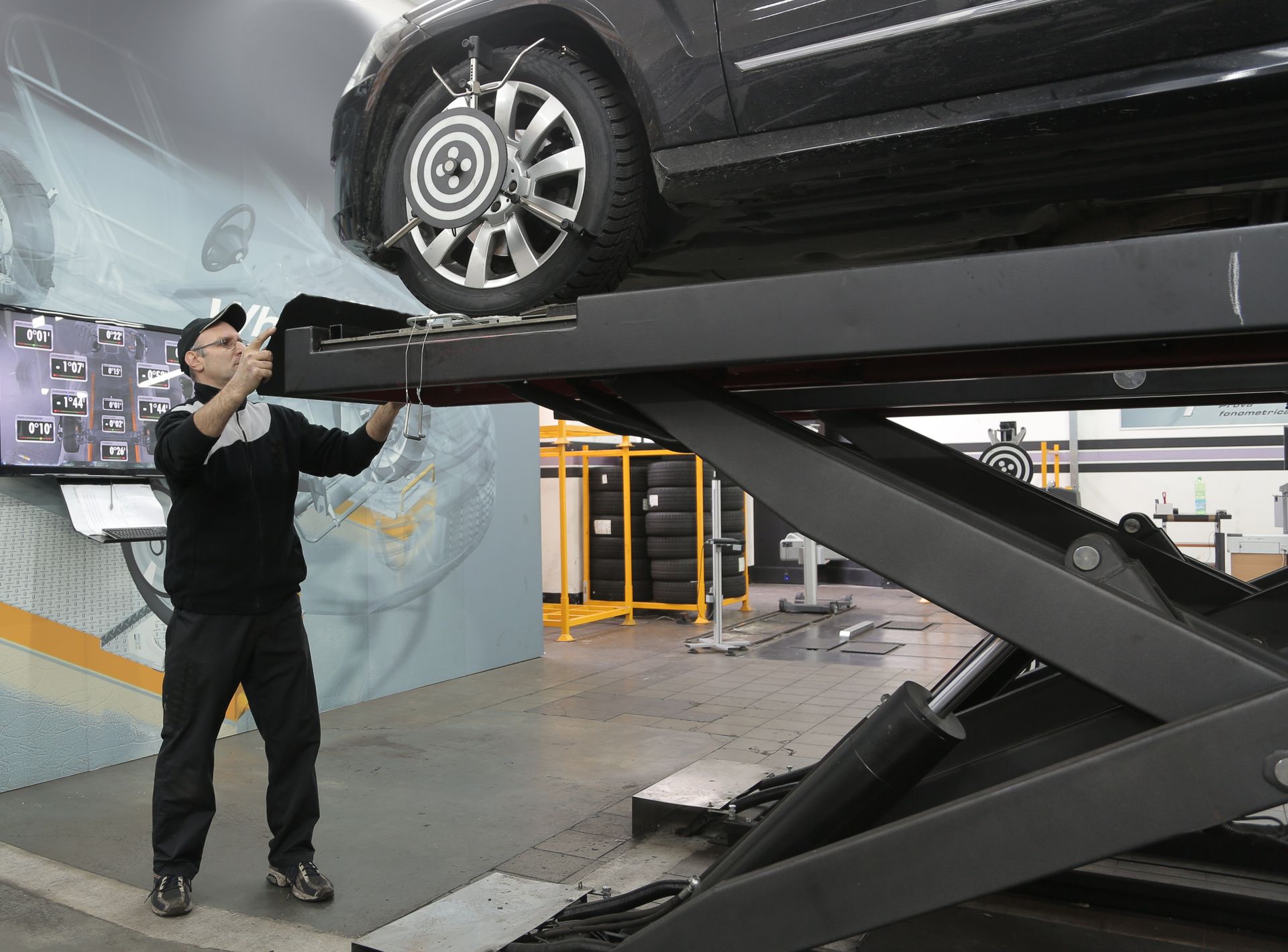
“Alignment” and “balancing” get mixed up constantly, and it’s easy to see why. Both involve your wheels, both affect how your car drives, and both come up during routine tire service. But they’re actually solving two completely different problems. Here’s a clear breakdown of what a wheel alignment does and what balancing does, why they’re not interchangeable, and how to know which one your car actually needs.
What a Wheel Alignment Actually Does
A wheel alignment adjusts the angles of your wheels so they’re pointed in the correct direction relative to each other and to the road. There are three main angles a technician checks and adjusts during an alignment:
- Camber is the inward or outward tilt of the wheel when viewed from the front.
- Toe describes whether the wheels point slightly inward or outward compared to straight ahead.
- Caster affects steering stability and how the wheel pivots.
When these angles fall out of spec, even slightly, it can affect how your car handles, how evenly your tires wear, and whether the car drives straight without you constantly correcting the wheel.
What Causes a Car to Fall Out of Alignment
Alignment doesn’t just drift out of spec randomly. It’s usually caused by something specific happening to the vehicle. Hitting a pothole, curb, or other road hazard is one of the most common causes, since the impact can knock suspension and steering components slightly out of position.
Worn suspension parts can also gradually throw off alignment over time, even without a specific incident. Normal wear and tear from regular driving plays a role too, which is why manufacturers typically recommend having alignment checked periodically rather than only after you notice a problem.
Signs Your Car Needs an Alignment
The tricky part about alignment issues is that they often start subtly, so subtly that a lot of drivers adjust to them without realizing anything’s actually wrong. You might find yourself gripping the wheel slightly off-center without thinking about it, or assuming a slight pull is just how the road is banked in that spot. A few clear signs tend to point toward an alignment issue rather than a balancing one:
- The car pulls to one side while driving on a flat, straight road, even when you’re not touching the steering wheel.
- The steering wheel is off-center when driving straight, sitting slightly crooked instead of level.
- Uneven tire wear, especially wear that’s concentrated on the inner or outer edge of a tire rather than spread evenly across the tread.
- The car feels like it wanders or requires constant small corrections to keep it going straight.
What Wheel Balancing Actually Does
Wheel balancing is a completely different process that addresses a different issue entirely. Every tire and wheel assembly has slight variations in weight distribution around its circumference, even when new. Balancing involves attaching small weights to the wheel to even out that weight distribution, so the tire spins smoothly without vibrating. Without proper balancing, a wheel can create a wobble or vibration that gets worse as speed increases, since the imbalance has more effect the faster the wheel spins.
Signs Your Car Needs Balancing
Balancing issues tend to show up differently than alignment problems, most notably through vibration. If you feel a shaking or vibration through the steering wheel, seat, or floorboard that gets more noticeable at highway speeds, that’s a strong sign one or more wheels are out of balance. This is especially common after getting new tires installed, since balancing is a standard part of that process, or after hitting a significant bump or pothole that could have dislodged a wheel weight.
Why the Two Get Confused So Often
It’s easy to see why people mix these up. Both involve your wheels, both are usually addressed at a tire shop, and both can affect ride comfort and tire wear if ignored. The confusion also comes from the fact that both issues can sometimes be present at the same time, especially after hitting a significant pothole, which can throw off alignment while also potentially damaging a wheel weight or the wheel itself. A thorough inspection can determine whether you’re dealing with one issue, the other, or both.
Why Getting the Right One Matters
Requesting the wrong service, or assuming one will fix a problem actually caused by the other, wastes both time and money. A wheel alignment won’t fix a vibration caused by an unbalanced wheel, and balancing won’t correct a car that’s pulling to one side due to misaligned angles. If your tires are already showing uneven wear from a long-standing alignment issue, balancing alone won’t stop that wear from continuing. Getting an accurate diagnosis upfront means you’re paying for the service that actually addresses what’s wrong.
How They Work Together
Even though alignment and balancing solve different problems, they work together to keep your ride smooth and your tires wearing evenly. A car that’s properly aligned but has an unbalanced wheel will still vibrate at speed. A car with balanced wheels but poor alignment will still pull to one side and wear its tires unevenly. Getting both checked periodically, rather than assuming one covers the other, is the best way to keep your car driving the way it should.
Staying Ahead of Both Issues
Regular preventative car maintenance, including having your alignment and tire balance checked periodically, especially after hitting a significant pothole or curb, can catch these issues before they lead to uneven tire wear or a rougher ride. It’s a relatively quick, affordable service compared to the cost of replacing tires that have worn unevenly due to a long-ignored alignment problem.
Not Sure Which One You Need?
If your car is pulling, vibrating, or just not driving the way it used to, you don’t need to figure out which service to ask for on your own. A quick inspection can determine exactly what’s going on and whether you need an alignment, a balance, or both.
Noticing your car pull to one side or vibrate at speed? Bring it in, and we’ll figure out exactly what’s going on, whether it’s alignment, balancing, or something else entirely. Contact us to schedule an appointment.